Cursor Just Picked a Side: What the SpaceX Deal Means for AI Coding
SpaceX's $10B/$60B option on Cursor signals a shift toward vertical AI coding stacks. Lock-in now spans model, harness, and GUI together, not just the model.
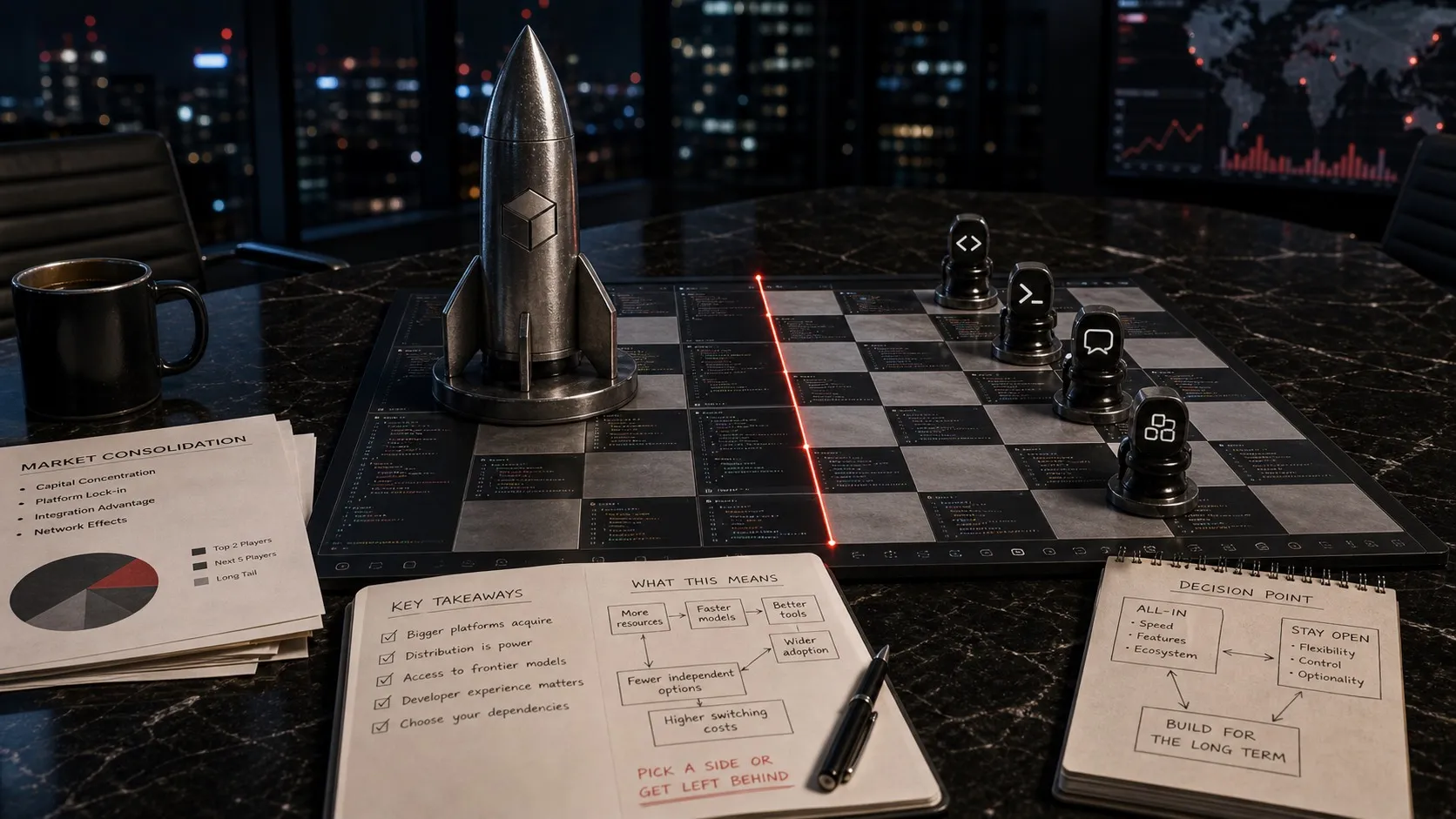
What Actually Happened
SpaceX announced an agreement with Cursor that works as an option. SpaceX can either pay $10 billion for a joint development partnership or acquire Cursor outright for $60 billion later this year. The choice is SpaceX’s.
The partnership plugs Cursor’s product and developer distribution into SpaceX’s Colossus supercomputer, which the company pitches as having compute equivalent to one million Nvidia H100 chips. Last week, xAI, which Musk merged with SpaceX in February at a claimed $1.25 trillion valuation, started renting compute to Cursor. Two senior Cursor engineers, Andrew Milich and Jason Ginsberg, have already moved to xAI and report directly to Musk.
At the same time, Cursor is in talks to raise $2 billion at a valuation above $50 billion, with Andreessen Horowitz co-leading and Nvidia and Thrive participating.
Put it all together. The lines between Cursor and Musk’s AI stack are being drawn now, regardless of which option SpaceX ultimately exercises.
What Cursor Was, and Where This Deal Points
Most developers know Cursor first as a GUI. A VS Code fork, yes, but the actual wedge was the interface: inline chat, tab autocomplete, Composer, a clean surface for AI-assisted editing. Under that GUI, Cursor wrapped heterogeneous models from outside (Claude, GPT, Gemini, and others) under its own harness (Composer), and shipped its own first-party auto-complete model on top.
That balance is what the deal puts pressure on. The question is whether the heterogeneous half of that balance survives. Will the defaults, the premium features, the onboarding, and the integration depth still point equally at Claude, GPT, and Gemini underneath, or will they tilt toward Grok and a Cursor harness increasingly co-tuned for xAI’s models?
I think it tilts. That is what acquisitions are for. That is what the incentives do. But I have a dog in this fight, so read on accordingly.
The xAI/Cursor Stack Is a Vertical Bet
What is being assembled here is a vertically integrated stack.
- Compute: Colossus, owned by SpaceX.
- Model: Some combination of Cursor’s model and Grok.
- Harness: Cursor’s agent loop (Composer), pulled in via partnership or acquisition.
- GUI: Cursor’s editor, the surface where developers actually sit.
- Talent: senior Cursor engineers already moved to xAI, reporting to Musk.
All of it, owned or controlled by one company. This is the same pattern OpenAI has with GPT and Codex, and Anthropic has with Claude and Claude Code. Musk is assembling his own mirror. That is the xAI/Cursor stack.
There is a legitimate engineering case for vertical stacks. Co-designing the model, the harness, and the GUI together can produce a more coherent product. OpenAI and Anthropic have shown that. But from the developer’s seat, a vertical stack also means one vendor owning every layer of how you write code.
What is Best for Developers
The short version: one UI to learn, one workflow to keep, and the freedom to swap whatever runs underneath.
That means the same rules, prompts, trackers, diagrams, and session history following you regardless of which agent ran the last task. It means being able to swap Claude Code for Codex for whatever harness is next, and Claude for GPT for Grok for whatever model is next, without rebuilding muscle memory. And it means heterogeneous agents running in parallel, on the same files, in the same workspace.
The workflow stays put. The model and harness underneath are interchangeable parts inside it.
What An Engineering Team Actually Needs
A team has the harder version of the same problem.
What teams need:
- One UI everyone learns. New hires learn the GUI once and use it for every model and harness the team touches. No retraining when the landscape moves.
- One workflow that stays put. Planning, tracking, reviewing, shipping, the same loop regardless of which agent is doing the work underneath.
- Shared context, portable across agents. Rules files, agents.md, prompt libraries, trackers, planning docs. All in the repo. All readable by whatever harness the developer picks today.
- Heterogeneous best-of-breed underneath. Claude Code for large refactors. Codex for tight edits. A new harness next quarter if it actually wins on something. No rewrite of the team’s conventions when the underlying tool changes.
- Multiple agents at once. Send one to refactor, another to write tests, a third to draft the PR description. Same files, one pane of glass, one review surface.
An Agnostic, Heterogeneous GUI
Full disclosure: I have a dog in this fight. We are building Nimbalyst to be the agnostic, heterogeneous GUI for agentic engineering. If you think vertical single-vendor stacks are the right long-term bet, the rest of this section is not for you.
The opposite of the vertical stack is a horizontal one. One GUI on top. Pluggable underneath. You pick the model, you pick the harness, you pick the agent, per task or per project or per vendor update.
Nimbalyst runs Claude Code and Codex side by side in the same workspace, on the same files, with a unified session view. Launch multiple sessions at once, one agent refactoring, another writing tests, a third drafting docs, and review the diffs together. Today that means Claude Code for a large refactor and Codex for tight edits or code review, without switching apps. Tomorrow, if Gemini CLI pulls ahead on documentation, or a new harness wins on debugging, or xAI ships something actually worth running, plug it in. The GUI does not change. The files do not change. Your rules, your trackers, your planning, your diagrams, your saved prompts, none of that cares which agent answered last time.
That is the point. The consolidation happening at the model and harness layers is real and is going to continue. The right response is not to pick the winner. It is to pick a GUI that does not force you to, and a workflow your team can keep regardless of which layer moves next.
And because Nimbalyst is a desktop app that edits real files on your disk, the GUI itself is not captive either. Your markdown is markdown. Your code is code. Your Excalidraw is JSON. Your tracker items are markdown with YAML frontmatter. Nothing about your work is stored in a format only one vendor can read.
Bottom Line
The $10B/$60B structure is a negotiation artifact. The real story is the direction of travel. The model vendors are buying the tool layer. Multi-model GUIs are an endangered category. Vertical single-vendor stacks are the new default.
For a developer, the cost of that default is learning a new UI every time the stack shifts, and losing whatever context was welded to the last one. For an engineering team, the cost compounds. Conventions fragment across vendors, onboarding restarts, and the team’s playbook becomes whichever GUI happens to be winning that quarter.
The durable alternative is the opposite direction. One UI to learn. One workflow to keep. All your context portable across agents. Best-of-breed harnesses and models underneath, swappable and runnable in parallel. Files you own.
Related posts
-
Windsurf vs Antigravity vs Cursor vs Nimbalyst (2026)
Windsurf vs Antigravity vs Cursor vs Nimbalyst compared in 2026. Features, parallel agents, browser testing, mobile access, and pricing.
-
Nimbalyst vs Cursor vs Windsurf (2026)
Compare Nimbalyst, Cursor, and Windsurf — three approaches to AI-assisted development. Features, architecture, pricing, and ideal use cases.
-
Best MCP Servers for Codex in 2026 (Ranked and Tested)
The best MCP servers for OpenAI Codex in 2026, ranked and tested: GitHub, Context7, Playwright, Postgres, Exa, and the essential picks, with the exact codex mcp add commands and the context-cost tradeoffs of running many at once.