Best Git Worktree Tools for AI Coding in 2026 (Compared)
Top tools for parallel AI coding agents on git worktrees in 2026. Nimbalyst, Conductor, Vibe Kanban, Claude Squad, Cline, Cursor, Windsurf, and more.
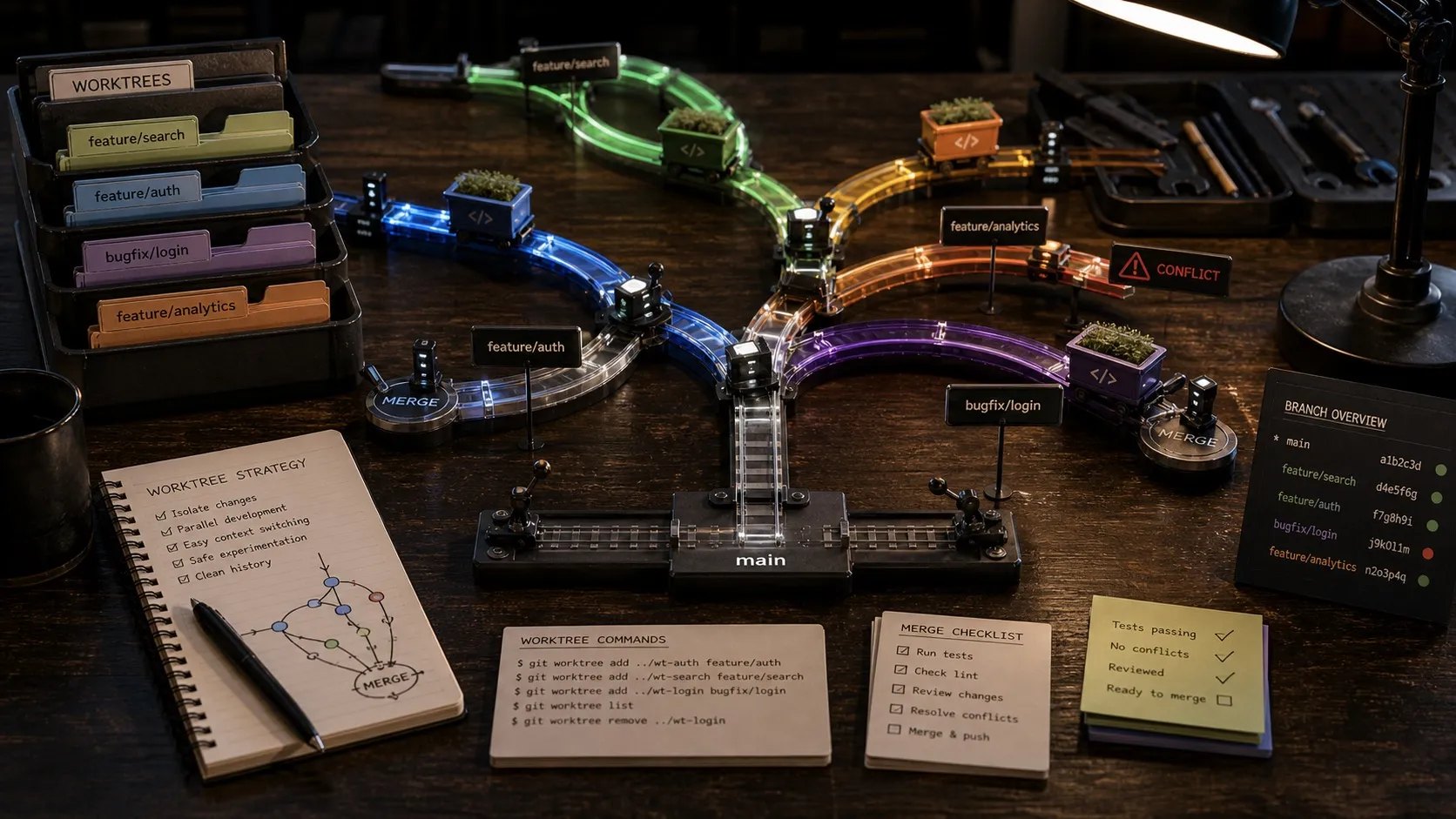
Git worktrees became load-bearing for AI coding somewhere in Q1 2026. As soon as you have two agents editing the same repo for more than ten minutes at a time, a single working directory stops working. They step on each other’s changes, race each other on package.json and lockfiles, and quietly overwrite each other’s work between tests. Worktrees give each agent its own directory on its own branch, sharing the one .git object database, so the agents can actually run in parallel.
By April 2026, almost every major AI coding tool shipped worktree support, and a new category of GUI managers and orchestrators grew up around them. I build Nimbalyst, a workspace where every AI session optionally runs in its own worktree, so I’ve compared most of these. Here’s a practitioner’s map: what each tool does, when it’s the right pick, and the pitfalls the setup tutorials don’t warn you about.
Quick picks
- Best if you want a visual workspace built around worktrees: Nimbalyst.
- Best if you want an orchestrator beside your existing editor: Conductor.
- Best open-source board-style option: Vibe Kanban.
- Best if you already live in the terminal: Claude Squad.
- Best if you want built-in worktrees in your IDE: Cursor, Windsurf, or Claude Code depending on your stack.
Why worktrees, specifically, and why now
A quick primer so the tool choices make sense.
A git worktree is a separate working directory linked to the same repository. Each worktree has its own branch checkout, its own index, its own files on disk. They all share the same .git database of commits, so history is consistent everywhere. The command git worktree add ../feature-branch feature-branch gives you a second directory on a second branch without re-cloning.
Before AI agents, worktrees were a niche power tool used mostly for building release branches without stashing in-progress work. With AI coding agents that autonomously edit files for 30-plus minutes, worktrees solve the fundamental problem of parallelism: two agents in the same directory will corrupt each other’s work. Two agents in two worktrees won’t. That’s why Cursor, Windsurf, Claude Code, Nimbalyst, and a whole new tier of orchestration tools now lean on worktrees as the isolation primitive.
One gotcha before we get to the products: git won’t let you check the same branch out in two worktrees. Either mint a unique branch per session (session/<id>) or run in detached HEAD. Most hand-rolled scripts get this wrong the first time.
The tool landscape
Visual workspaces (worktree as a first-class primitive)
Nimbalyst
The one I build, so full disclosure. Cross-platform desktop plus iOS companion. Every AI coding session can optionally spawn its own worktree on its own branch. The session kanban in the sidebar makes it cheap to scan parallel agents at once, each in its own worktree with its own diff review panel. Supports Claude Code and Codex natively, plus other agents as they ship.
Strength: worktrees are a first-class citizen of the session object, surfaced as a one-click option when you start a session rather than a hand-typed flag. Inline diffs per session, visual files sidebar, and the merge step is a review-and-accept in the GUI rather than a terminal dance. The free plan includes optional worktree-per-session.
Weakness: you need to be willing to adopt a new workspace.
Conductor (Melty Labs)
The best visual dashboard experience for Mac users who want to stay in their existing editor. Free, bring-your-own Claude or Codex login. Diff-first review, one worktree per agent, clean polish throughout.
Originally Mac-only; cross-platform support has been trickling in. If you’re on macOS and you want an orchestrator-only tool next to your existing VS Code or JetBrains setup, Conductor is hard to beat.
Weakness: historically Mac-only, smaller platform surface than Nimbalyst.
Vibe Kanban (BloopAI)
Open source, cross-platform. Kanban card = worktree = agent. Supports 10-plus CLI agents (Claude Code, Codex, Gemini CLI, Copilot CLI, Amp, Cursor, OpenCode, Droid, Aider, Qwen). Free self-hosted, Pro tier for cloud. Note: Bloop shut down in April 2026 and the project moved to community-maintained open source.
Strongest choice if you want team-board semantics or self-hosting on your own infra. The agent-agnostic stance is great for teams mixing providers.
Superset
YC-backed IDE for running 10-plus parallel agents in a unified dashboard. Worktree per agent across Claude Code, Codex, OpenCode. Newer than the others, worth watching.
Terminal and tmux-first
Claude Squad
Zero-setup tmux wrapper. Free, open source. Puts multiple Claude Code or Codex agents into background tmux panes, each in its own worktree. The pick for keyboard-only power users who already live in tmux and don’t want a new GUI.
Weakness: weak visual diff review. You end up opening a separate tool for the review step.
Cline
Cline’s CLI and broader ecosystem make it a viable option if you want worktree-based parallelism without giving up open-source tooling. It is especially appealing if you want the same underlying workflow to work in CI as well as locally.
Worktree-aware coding agents and IDEs
Claude Code (built-in worktree support)
Claude Code now ships native worktree isolation. Add isolation: worktree to a subagent’s frontmatter, or just tell Claude to use worktrees for your agents. Worktrees land in .claude/worktrees/ by default.
This is the lowest-friction way to get worktree isolation without adopting a new tool. The tradeoff: you’re still in the terminal or the Claude Code GUI, so the visual cross-session management isn’t as strong as a dedicated workspace.
Cursor 3
Released April 2, 2026. The Agents Window runs agents across local directories, cloud sandboxes, remote SSH, or worktrees. /worktree and /best-of-n are exactly the kinds of commands that made worktrees feel normal rather than niche.
Windsurf Wave 13
Shipped late December 2025. True parallel Cascade sessions with worktrees, a dedicated agent terminal, and a free SWE-1.5 trial. Multi-pane layout for side-by-side monitoring.
Autonomous pipelines (low human-in-the-loop)
Gastown
Steve Yegge’s project. Think “Kubernetes for AI coding agents.” Many parallel agents on worktrees, coordinated through Beads as a data and control plane. It is not a casual adoption. It is useful partly as a tool and partly as a proof of what maximum-scale agent orchestration looks like.
OpenClaw + Antfarm
Steve Yegge’s Gastown pattern adapted into a more accessible stack. Antfarm (Ryan Carson) provides the Ralph Loop orchestrator over OpenClaw, running atomic stories each in its own worktree via cron, YAML config, and SQLite. Best for overnight unattended runs with deterministic verification.
General git GUIs with worktree support
GitKraken 10.5+ and Tower 9
Not AI tools, but both exposed worktree create, switch, lock, and remove actions in their sidebars during 2025 updates. If you’re managing worktrees by hand and running agents separately in terminals, these are the polished options. Tower 9 added Windows-native worktree commands in early 2026.
Utility tools worth knowing
Worktrunk
Pure CLI from Maximilian Roos. Three-command ergonomics (worktrunk new, worktrunk clean, a hook runner). The “git-for-agents” plumbing many of the above GUIs sit on top of. Best for scripting your own workflow.
Clash
Open source. Predicts merge conflicts between worktrees before they happen. Warns when two agents in parallel worktrees are about to overlap on the same function or class. One of the smartest tools in the ecosystem because it addresses the next failure mode after worktrees solve file collisions.
Three things the tutorials don’t tell you
Setup guides for worktrees get the git worktree add command right and stop there. After nine months of running this for real, the problems are further down.
Worktrees solve file collisions, not semantic conflicts. Two agents editing the same function in two worktrees will merge cleanly into a broken build. Worktrees protect you at the file system level. They do not protect you at the logic level. Pair worktrees with a conflict predictor (Clash) or, more reliably, with task decomposition that gives each agent a disjoint surface.
Shared runtime is a bigger killer than shared files. Worktrees still share ports, databases, environment variables, package caches, and test state. Five agents each trying to run npm run dev on port 3000 will fail loudly. Five agents each calling the same development Stripe account will fail silently and produce charges or webhooks that look real but aren’t attributable. Isolate runtime (port ranges, per-worktree .env, scratch databases) before you fan out parallel agents.
One branch is one worktree. Git refuses to check the same branch out twice. At scale, you need unique branch names per session (session/<sha> is a reasonable pattern) or you run in detached HEAD and commit through PRs. The hand-rolled scripts that pop up in tutorials all miss this and fail silently the third time you try to parallelize.
How to pick
Solo developer on macOS, want to stay in VS Code or JetBrains: Conductor. Orchestration next to your existing editor.
Cross-platform team with shared boards and self-hosted ambitions: Vibe Kanban. Open source, team-friendly, agent-agnostic.
Power user who lives in tmux: Claude Squad.
Already on Claude Code and just want worktrees without adopting a new tool: Claude Code’s built-in isolation: worktree.
IDE-shaped workflow with tiled multi-agent panes: Cursor 3 Agents Window or Windsurf Wave 13.
Unattended overnight multi-agent runs: Gastown, OpenClaw plus Antfarm. You give up the interactive loop but get deterministic automation.
All of the above, cross-platform, with a visual workspace, session kanban, heterogeneous agents, and worktrees as a first-class primitive: Nimbalyst. Built for this!
Closing
Worktrees stopped being a power-user trick in 2026 and became the isolation layer every serious AI coding workflow needs. The tools above all handle the mechanics. The differences are about how much visual feedback you get, whether the human-in-the-loop review is one click or fifteen, and how well the tool supports multiple agents at once.
Pick based on your editor preference and your scale. If you’re running two or three parallel agents a day, Conductor or Claude Code’s built-in worktree support is plenty. If you’re running 5-10, a visual workspace (Nimbalyst, Vibe Kanban, Cursor 3’s Agents Window) starts to pay for itself. If you’re running 20 or more, you’re in Gastown territory and you need to think about coordination, not just isolation.
The one mistake I’d avoid is treating worktrees as sufficient. They’re necessary. They’re not sufficient. Pair them with runtime isolation, a conflict predictor if you can, and a review step that sees all the agents’ output in one place.
Nimbalyst is my take on that review-and-isolation primitive. If you’re already comfortable in Cursor 3 or Claude Code, their worktree support is likely enough on its own. Either way, run your next parallel session with one worktree per agent and see how much less debugging time you spend.
Related reading: Best Multi-Agent Coding Tools in 2026 and Best Tools for Running Parallel AI Coding Agents.
FAQ
Why use git worktrees for AI coding?
Because the moment two agents share one working directory, they can trample each other’s files and state. Worktrees give each session its own branch and checkout without forcing you to clone the repo over and over.
Do worktrees prevent merge conflicts?
They prevent working-directory collisions. They do not prevent semantic conflicts. Two agents can still make incompatible changes in different branches.
What is the best git worktree tool for AI coding teams?
If you want a visual review layer around worktrees, use Nimbalyst or Conductor. If you want open source and board-style orchestration, use Vibe Kanban. If you just want built-in worktrees inside an existing coding tool, Cursor, Windsurf, and Claude Code are all viable.
Related Reading
- Best multi-agent coding tools for Claude Code and Codex users — the orchestration layer that runs on top of worktrees.
- Best tools for running parallel AI coding agents — going deeper on parallel sessions.
- Best session managers for Claude Code and Codex — managing the sessions across worktrees.
Karl Wirth is the founder of Nimbalyst, a desktop workspace for multi-agent coding with optional one-click git worktree isolation per session.
Related posts
-
How to Run Coding Agents in Parallel with Git Worktrees
A step-by-step guide to running Claude Code and Codex sessions in parallel using git worktrees: creating them, making them runnable, reviewing the output, and merging without collisions.
-
Best Multi-Agent Coding Tools for Claude Code and Codex Users (2026)
Multi-agent coding tools compared for Claude Code and Codex users. Cursor, Codex app, Conductor, Vibe Kanban, Claude Squad, Nimbalyst, by orchestration model.
-
Best Tools for Parallel AI Coding Agents (2026)
Compare the best tools for running multiple Claude Code and Codex sessions in parallel — ccmanager, dmux, Superset, agentree, and Nimbalyst.