Best Vibe Coding Tools for Claude Code and Codex Users (2026)
Vibe coding tools for developers using Claude Code or Codex. How prompt-to-app builders, AI-native IDEs, and visual workspaces fit with your agent.
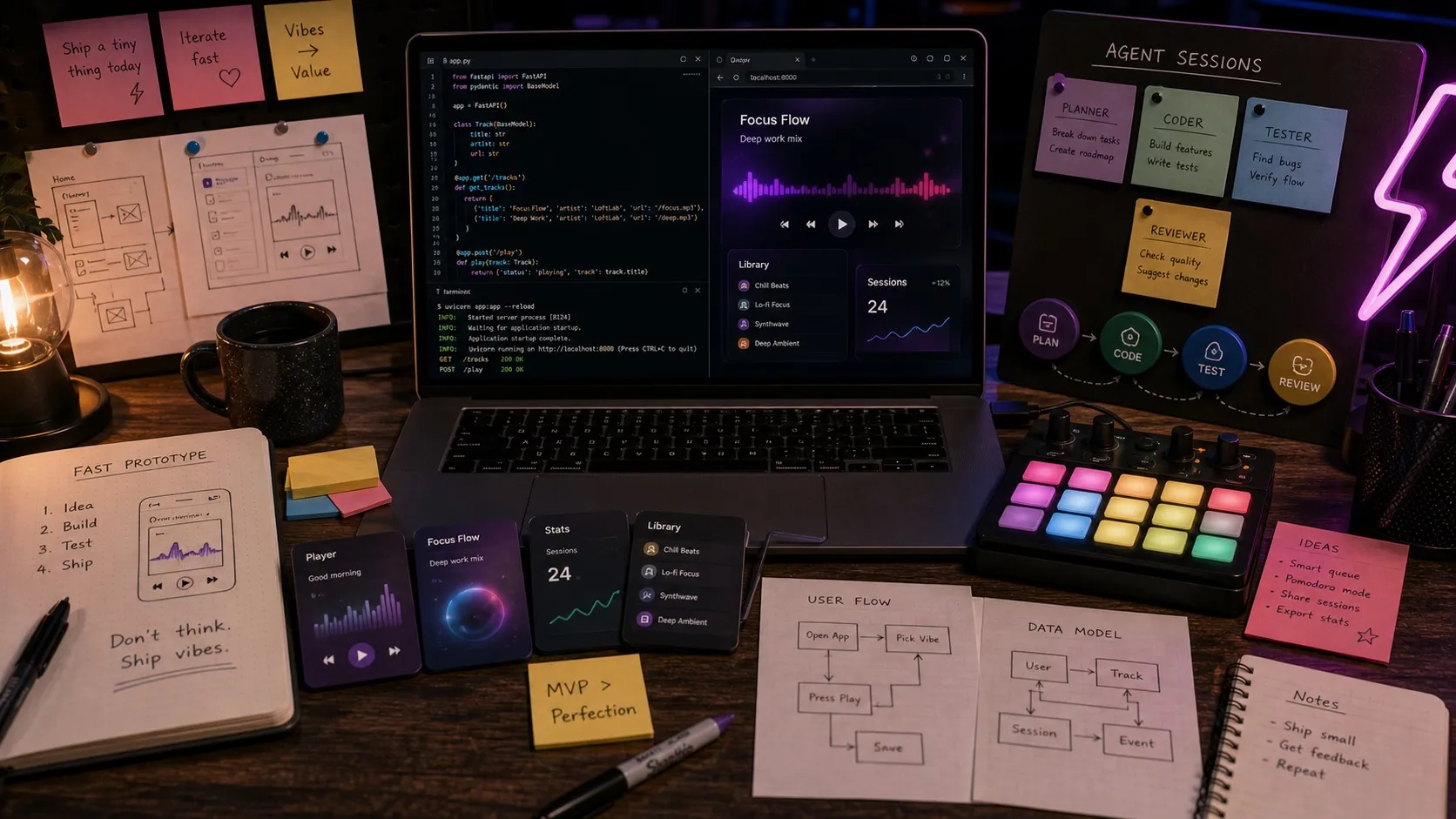
Best Vibe Coding Tools When You Already Use Claude Code or Codex
If you already run Claude Code or Codex every day, the question is not “what is vibe coding?” It is “which vibe coding tools actually fit alongside the agent I am already using?” This guide answers that.
Most vibe coding roundups treat the category as if Lovable, Bolt, Cursor, and Claude Code all compete for the same job. They do not. Lovable and Bolt are great for spinning a brand-new app out of a prompt. Claude Code and Codex are the agents you reach for once you have a real codebase. And there is a third layer most lists ignore: the visual workspace that wraps around those agents so you can plan, review, and run multiple sessions in parallel.
This guide organizes the tools by which job they actually do, with a specific lens on how each one plays with Claude Code and Codex. The goal is to help you decide what to add to your stack, not to convince you to throw out the agent that already works.
For the broader category framing, see our breakdown of vibe coding vs AI coding.
What Makes a Good AI-Assisted Coding Tool
Before comparing tools, it helps to know what separates the useful ones from the impressive-but-limited demos. The criteria shift depending on whether you are doing greenfield vibe coding or working with an existing codebase:
- Context awareness. Vibe coding tools need to understand your prompt well. AI coding tools need to understand your entire project — file tree, dependencies, patterns, conventions.
- Iteration speed. First-pass output is never perfect. The tool should make it fast to refine, not just fast to generate.
- Output quality. Clean, maintainable code. For vibe coding, that means working code fast. For AI coding, it means code that follows your existing conventions and passes your test suite.
- Reviewability. You need to see what changed and why. Diffs, not black boxes. This matters more as projects grow.
- Deployment path. Can you actually ship what the tool produces? Or does it live in a sandbox forever?
Different tool categories prioritize different traits. That is why no single tool wins everything.
Full-Stack Builders: From Prompt to Deployed App
These tools target the fastest path from idea to working application. You describe what you want, and they generate a full-stack app — frontend, backend, database, deployment.
Lovable
Lovable generates complete web applications from natural language prompts. You describe your app, it builds a React frontend with a Supabase backend, and you get a live deployment. It handles auth, database schema, and basic CRUD operations out of the box.
Where it shines is speed to first version. You can have a functional MVP in minutes. The code it generates is real, exportable, and connects to Git for handoff to a traditional development workflow.
The limitation is customization depth. Once your app outgrows what Lovable can scaffold, you are back in a code editor making manual changes. It is a starting gun, not a finish line.
Bolt.new
Bolt.new runs entirely in the browser using StackBlitz WebContainers. No local setup, no environment configuration. You prompt, it builds, you see the result instantly in a browser preview.
The zero-setup experience makes it the fastest way to prototype. It supports multiple frameworks and the iteration loop is tight — you can prompt changes and see them reflected in seconds.
The tradeoff is that WebContainers have limits. Complex backend logic, native dependencies, and production-grade infrastructure are outside its scope. For prototypes and demos, it is hard to beat. For production apps, you will outgrow it.
Replit Agent
Replit Agent takes a different approach by combining AI generation with a full cloud development environment. You describe your app in plain text, the agent builds it, and you can deploy directly from Replit’s infrastructure.
The key advantage is the end-to-end loop. Environment, code generation, package management, and deployment all live in one place. You never leave the browser.
Replit’s pricing model is usage-based, which can get expensive for sustained development. And like other full-stack builders, the agent works best for greenfield apps — retrofitting it into an existing codebase is a different story.
v0 by Vercel
v0 specializes in generating polished React and Next.js interfaces. Where other builders aim for full-stack apps, v0 focuses on the frontend and does it well. The components it generates are production-quality, use shadcn/ui conventions, and integrate cleanly with the Next.js ecosystem.
If your stack is React and you need UI fast, v0 is the best single-purpose tool for the job. It does not try to be your backend or your database — it does one thing and does it at a high level.
AI-Native IDEs: Vibe Coding Inside Your Editor
These tools modify the traditional AI IDE experience by embedding AI deeply into the editing workflow. You still work in files, still use version control, still manage your own stack — but the AI is a first-class collaborator.
Cursor
Cursor is the market leader in AI-native IDEs, and for good reason. Built as a VS Code fork, it preserves the extension ecosystem and keyboard shortcuts you already know while adding agent mode, multi-file edits, inline chat, and background agents.
At $20/month for Pro (and up to $60/month for Ultra with more compute), Cursor targets professional developers who want AI acceleration without leaving their existing workflow. The agent mode can execute multi-step plans, create files, run commands, and iterate on errors autonomously.
Cursor reportedly crossed $2B in annual recurring revenue, which tells you how many developers have adopted it as their primary editor. The VS Code familiarity is a massive advantage — there is almost no learning curve if you are already a VS Code user.
The weakness is that Cursor is still fundamentally a code editor. Planning, documentation, visual mockups, and project management happen somewhere else.
Windsurf
Windsurf (formerly Codeium) positions itself as the “flow state” AI IDE. Its Cascade agent emphasizes maintaining context across long coding sessions, understanding not just what you asked for but what you have been working on.
At $20/month (recently raised from $15), it matches Cursor on price. The Cascade agent handles multi-file edits and can reason about your codebase structure. Cognition AI acquired Windsurf for roughly $250M, signaling serious investment in the product.
Windsurf is a strong alternative to Cursor, especially if you value the lower price point. The flow state philosophy — keeping the AI aware of your broader session context — is genuinely useful for complex refactoring work.
AI Coding Agents: Where Vibe Coding Becomes AI Coding
This is where the line between vibe coding and AI coding blurs. These tools started as terminal agents but have expanded into full multi-surface platforms — CLI, desktop apps, IDE extensions, and web interfaces. They can spin up new projects from a prompt, but their real power is working with existing codebases. They read your entire project, follow your conventions, run your tests, and iterate until things pass. That is AI coding, not just vibes.
Claude Code
Claude Code is the most-loved AI coding tool in developer surveys, with 71% of developers who use AI agents reporting they use it. It started as a terminal CLI but has grown into a multi-surface platform available everywhere: the original terminal CLI, a VS Code extension (also works in Cursor), the Code tab in the Claude Desktop app, a web interface at claude.ai/code, a JetBrains plugin in beta, and even Claude Cowork for non-technical users.
Powered by Claude Opus 4.6 (with Sonnet 4.6 as the default on lower tiers), Claude Code operates directly on your file system. It reads your project structure, understands your conventions (via CLAUDE.md files), executes shell commands, runs tests, and commits code. It supports MCP (Model Context Protocol) servers for extending with custom tools, sub-agents that work in parallel on different parts of a task, git worktree isolation, and scheduled tasks that run even when your computer is off.
Pricing starts at $20/month (Pro) with Sonnet 4.6 as the default model. Max plans at $100-200/month unlock Opus 4.6 with 1M context windows and higher rate limits. For more on getting the most out of agent-driven development, see our guide to coding with AI agents best practices.
What makes Claude Code stand apart is depth. It does not just generate code. It reads your entire project context, follows your patterns, runs your test suite, and iterates until tests pass. The multi-surface availability means you can start a task in the terminal, check progress from the web or your phone, and review changes in the desktop app.
Codex
Codex is OpenAI’s answer to Claude Code. Like Claude Code, it has grown well beyond its terminal origins. The open-source CLI (67K+ GitHub stars) is now joined by Codex Cloud at chatgpt.com/codex for async task delegation, a native desktop app (macOS and Windows) that serves as a multi-agent command center, an IDE extension for VS Code and Cursor, and integration as an agent inside GitHub Copilot.
The desktop app, launched in February 2026, organizes work into parallel threads by project, with built-in Git integration, worktree support, Skills (reusable workflows), and Automations (scheduled background tasks). Codex Cloud lets you assign tasks that run asynchronously in isolated containers for 1-30 minutes while you do other work.
Codex is included with any ChatGPT subscription — Plus at $20/month, Pro at $200/month. The current default model is GPT-5.4. The sandboxed execution model limits network access by default, which is both a security feature and a constraint you will need to work around for tasks that require package installation or API calls.
Claude Code currently leads in overall market adoption and SWE-bench scores for complex multi-file refactoring. Codex leads on terminal debugging benchmarks and token efficiency. Many developers are adopting hybrid workflows — Claude Code for feature generation, Codex for code review.
Workspace Tools: The Layer Above
Here is the gap that none of the tools above fill: planning, reviewing, and managing the work that surrounds coding.
AI coding agents write code across more surfaces than ever, but you still need to plan what they should build. IDEs show you files, but you still need to see the bigger picture. Full-stack builders generate apps, but you still need to write specs, review changes across file types, and manage multiple workstreams.
Nimbalyst
Nimbalyst is a visual workspace built on top of Claude Code and Codex. It is not a replacement for them — it is the layer where you plan work, launch agent sessions, review changes, and manage everything visually.
The core idea is that vibe coding involves more than just code. You need to write specs. Sketch UI mockups. Draw architecture diagrams. Map out data models. Track tasks. Review diffs. And you need to do all of that while running multiple AI coding sessions in parallel.
Nimbalyst provides 7+ visual editors in one workspace: WYSIWYG markdown for specs and planning docs, Monaco code editor, CSV spreadsheet editor, a UI mockup tool (MockupLM) for designing interfaces, Excalidraw for diagrams, a data model / ERD editor, and Mermaid diagram support. Every editor type shows inline red/green diffs — not just code files, but markdown, mockups, and diagrams too.
The session kanban board lets you run and manage multiple Claude Code sessions simultaneously. Any session can opt into its own git worktree with one click, so when you want isolation, agents working in parallel never step on each other. You see all your active sessions, their status, and their changes in one view.
It also includes a built-in task tracker, git integration, and terminal access. The desktop app runs on Mac, Windows, and Linux, with an iOS companion app for reviewing work on the go. It is free for individuals.
Nimbalyst does not compete with Cursor or Claude Code. It wraps around them. If Claude Code is the engine, Nimbalyst is the dashboard and steering wheel.
Comparison Table
| Tool | Category | Price | Open source | Best For | Limitation |
|---|---|---|---|---|---|
| Cursor | AI-Native IDE | $20-200/mo | Closed | Professional devs wanting AI in VS Code | Code-only, no planning tools |
| Windsurf | AI-Native IDE | $20/mo | Closed | Flow state coding, Devin integration | Smaller ecosystem than Cursor |
| Claude Code | AI Coding Agent | $20-200/mo | CLI yes; apps no | Deep codebase work, multi-surface flexibility | Planning and visual review happen elsewhere |
| Codex | AI Coding Agent | $20-200/mo (ChatGPT) | CLI yes (Apache 2.0); App no | Async cloud tasks, OpenAI ecosystem | Sandboxed — network off by default |
| Lovable | Full-Stack Builder | Free/$20-100/mo | Closed | Fast MVPs, non-technical founders | Hard to customize past scaffolding |
| Bolt.new | Full-Stack Builder | Free/$20-200/mo | Closed | Instant prototyping, zero setup | WebContainer limits for production |
| Replit Agent | Full-Stack Builder | Free/$20-100/mo | Closed | End-to-end browser dev | Can get expensive at scale |
| v0 | Full-Stack Platform | Free/$20-100/mo | Closed | React/Next.js, now full-stack | Vercel ecosystem lock-in |
| Nimbalyst | Visual Workspace | Free for individuals | Yes — MIT (github.com/Nimbalyst/nimbalyst) | Planning + multi-agent management | Built on top of other agents |
Who Should Use What
If you are a solo developer who lives in the terminal and works on a single project at a time, Claude Code is probably all you need. Add Nimbalyst when you find yourself juggling multiple agent sessions or want visual editors for specs and mockups.
If you are coming from VS Code and want the lowest friction path to AI-assisted coding, Cursor is the obvious choice. Windsurf if the price matters.
If you are a founder or PM who needs a working prototype fast and does not want to touch code, start with Lovable or Bolt.new. Hand off to a developer (or Claude Code) when you need production quality.
If you are managing multiple workstreams — several features in parallel, specs to write, agents to supervise, changes to review — Nimbalyst is the workspace that ties it together. It does not replace your coding tool. It gives you the planning and management layer that coding tools lack.
If you want to try the full vibe coding stack: Write your spec in Nimbalyst, launch a Claude Code session from the kanban board, review the diffs visually across all file types, and ship. That is the workflow that works.
The Category Is Still Moving Fast
A year from now this list will look different. Tools will merge, new ones will appear, and the boundaries between vibe coding and AI coding will continue to blur. The prompt-to-app builders will get better at existing codebases. The terminal agents will get better at greenfield generation.
What will not change is the underlying question: are you starting from scratch, or working with existing code? The answer determines which tools matter most. For a deeper look at that distinction, see our full breakdown of vibe coding vs AI coding.
The best tool is the one that fits how you work. Try a few. The switching costs are low and the productivity gains are real.
For a closer look at what a vibe coding workspace looks like in practice, see our Vibe Coding Workspace page.
Related Reading
- Best AI IDEs for Claude Code and Codex users — the editor side of the same workflow.
- Best multi-agent coding tools for Claude Code and Codex users — when one session is not enough.
- Best Claude Code GUI in 2026: four active Claude Code GUI tools compared.
Related posts
-
Best AI Agent Orchestration Platforms 2026: Coding vs Workflow
AI agent orchestration means two different products. Compare control planes for your own coding agents (Nimbalyst, Orca, Emdash, Superset, Conductor, Warp) against workflow frameworks like LangGraph and CrewAI.
-
OpenCode vs Codex vs Claude Code (2026 Comparison)
OpenCode vs Codex vs Claude Code compared in 2026: architecture, benchmarks, pricing, model lock-in, and which AI coding agent to pick.
-
Best Conductor Alternatives 2026: Windows, Linux, and Open Source
Conductor is macOS only. The best Conductor alternatives in 2026 compared on platform support, agent coverage, licensing, and worktree isolation.