Overwhelmed Working with Coding Agents? Have Them Write You a Wiki
Running several Claude Code or Codex sessions produces more decisions and open questions than one person can track. Here is the approach we use: the agents distill their work into a short wiki for you, and you read, think and set direction.
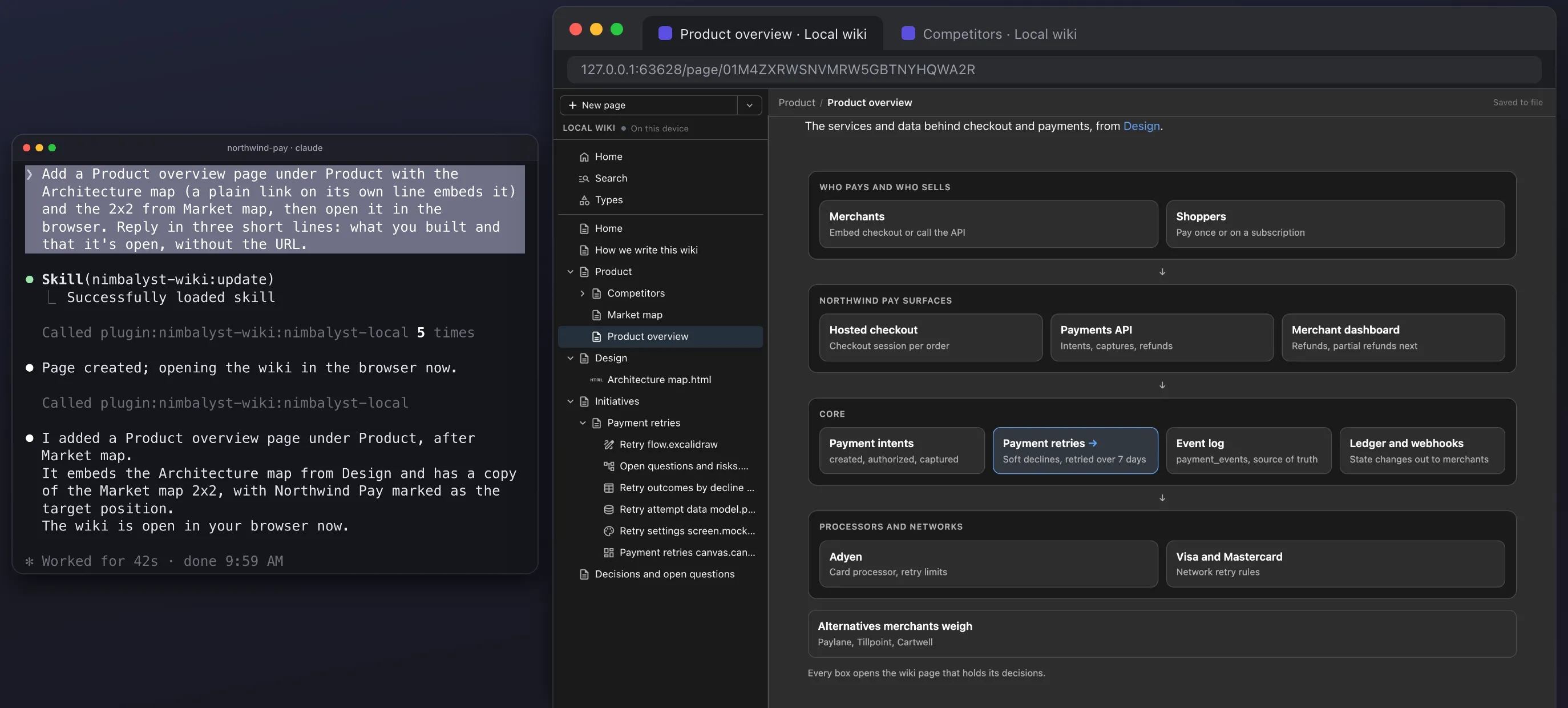
If you feel overwhelmed and disorganized working with coding agents, the cause is volume. Several Claude Code or Codex sessions a day produce more plans, decisions and open questions than one person can read, and the important ones end up buried in transcripts. The approach that has worked for us is to have the agents distill their work into a short wiki written for you, so you read a page of what was decided and what is still open, instead of trying to remember it.
What the overwhelm looks like
You start the morning with three sessions. One is refactoring payment retries, one is chasing a flaky test, one is drafting a migration plan. By lunch each has asked you something, and you answered in the moment: yes, use the event queue; no, keep the old endpoint for now; we can decide about the mobile SDK later.
By Thursday you cannot say which of those answers were final. A new session proposes the option you rejected on Monday, and you are not sure enough to say no, because the reason lives in a transcript you will never scroll back through. The open question about the mobile SDK has no owner. If you switch between Claude Code and Codex, each one knows only its own half of the week.
The agents are doing what you asked. You are the only place where all of their work comes together, and there is more of it than one person can hold.
Why the usual fixes do not cover it
Instruction files such as CLAUDE.md and AGENTS.md hold the rules an agent follows on every task. They work best short and imperative, and they are written for the agent. A decision with its reasons and rejected options does not fit in them, and putting it there buries the instructions.
Agent memory, such as Claude Code’s auto memory or Codex memories, helps the agent recall your preferences next time. It is also written for the agent, organized so the agent can find things, and you rarely read it. We compare Claude Code memory with a wiki written for you in a separate post.
A team wiki or doc tool is written by people, and the people directing agents are the ones with no time to write. It falls behind in a week.
Reading the transcripts works for one session and breaks down at fifteen.
Each of these serves the agent or the team well. What the person making the calls needs on top of them is a short, current account of the project written for them.
What helped: the agents write it, you read it
We now keep a wiki for each project that the agents write for us, an idea close to Andrej Karpathy’s LLM wiki, where the agent writes the pages and the person reads them. Three rules make it work.
The agent writes, you read and edit. At the end of a session, the agent records what was decided in the page it affects. You never start from a blank page, and you never maintain it by hand. When you disagree with a page, you edit it, and the next session works from your version.
Only what someone needs to think about or decide. A decision goes in with who made it, when, and what was passed over. An open question goes in with an owner. Things you track, such as competitors, customers or features, become typed pages with a table of all of them. The work itself stays in your sessions, code and trackers, and the wiki links to it. The test we use for every note: a strong model would get it wrong without it, a person chose it or needed it to choose, and it will still matter after the code changes.
One wiki across every agent. The pages are markdown files in your repo, so Claude Code, Codex, Cursor and the rest all write to the same place. Switching agents does not split the record.
Here is what a decision looks like in a page:
[We retry failed charges through the event queue.]{decided by="Dana Lee" [email protected] on=2026-10-14 over="retrying inside the payment provider client"}The reason sits in the next sentence, and when your own words in the session support it, the agent adds a quote copied from the transcript. It never invents a decision or a quote. We go deeper on decision records your coding agent writes.
A week with it
On Monday, run setup once. The agent reads the README and docs, asks you a few questions about who the wiki is for, and writes a Home page, a writing guide and starter pages (how setup works).
Through the week, each session ends with a capture step. In Claude Code the plugin reminds the agent to do it after a session with a commit, a plan or several file edits. The agent writes the decisions and open questions into the right pages and tells you which pages it touched. The capture docs show exactly what it records.
On Friday, open the wiki in your browser and read the index of decisions and open questions. A week of sessions takes a few minutes to review. You reassign the question nobody owns, fix the one decision the agent recorded too loosely, and reorder the priorities on the Home page. Next week’s sessions start from what you wrote.
When a new session proposes the option you already rejected, ask it “why did we decide against this?” and it answers from the wiki, with the date, the owner and the reason.
Try it
We built this as the Nimbalyst Wiki, a free plugin for Claude Code and Codex that also works in Cursor, VS Code, Cowork and any MCP agent. The pages are plain markdown in your repo, you read and edit them in your browser, and there is no app or account to set up. It is MIT licensed and the source is on GitHub. We keep one for Nimbalyst itself.
In Claude Code:
/plugin marketplace add nimbalyst/nimbalyst-wiki
/plugin install nimbalyst-wiki@nimbalyst-wiki
/nimbalyst-wiki:setup
The step-by-step guides for Claude Code, Codex and Cursor, VS Code and Cowork cover the rest. If you have tried other ways of keeping up with your agents, we would like to hear what worked in the repo’s Discussions.
FAQ
Why do coding agents feel overwhelming? Several sessions a day produce more decisions and open questions than one person can read, and they end up buried in transcripts.
How do I keep track of decisions across sessions? Have the agent write each one into a wiki page at the end of the session, with who decided, when and what was rejected, and read the index of decisions and open questions once a week.
Isn’t CLAUDE.md or AGENTS.md enough? They hold the rules agents follow and work best short. A decision’s reasons and rejected options belong in pages written for you.
Do I have to write the wiki myself? No. The agent writes it from its work, and you edit what you disagree with.
Related pages
-
Nimbalyst Wiki
A local wiki your coding agents write for you, so you can think, organize and set direction.
-
Architecture Decision Records Written by Your Coding Agent
Decisions in the page they affect, with who, when and what was rejected.
-
How to Keep a Project Wiki with Claude Code
Install, setup, capture and recall with the Claude Code plugin.
-
Claude Code Memory vs a Wiki Your Agents Write
Where CLAUDE.md, AGENTS.md, auto memory and a wiki for you each fit.
-
Docs: Read and Edit the Wiki in Your Browser
The local browser view, from your agent or nim wiki serve.
Related posts
-
Architecture Decision Records Written by Your Coding Agent
How to keep architecture decision records and a decision log when Claude Code and Codex make decisions faster than anyone writes them down: the agent records each decision in the page it affects, with who decided, when, what was rejected and a quote from the session.
-
AGENTS.md vs CLAUDE.md: Where Instructions Go, and Where Decisions Go
AGENTS.md and CLAUDE.md both hold instructions for coding agents. Here is how they differ, how Claude Code reads each one today, and where your decisions and open questions should live instead.
-
How to Keep a Project Wiki with Codex
Add the free Nimbalyst Wiki to Codex with the Codex CLI plugin or one codex mcp add command for the Codex app and IDE extension. Codex writes a markdown wiki of decisions and open questions in your repo that you read and edit in your browser.