Capture Decisions at the End of a Session
Have Claude Code, Codex, or any MCP agent record what a session decided in the wiki pages it affects: who decided, when, and what was passed over, open questions with owners, and quotes from the session.
Capture turns a session into a few marked sentences in your wiki. At the end of a session, your agent finds the page each decision affects and writes it there, with who decided, when, and what was passed over, and records the questions that were answered or left open. You keep a current record of the project without writing it yourself.
Run capture
In Claude Code, with the Nimbalyst Wiki plugin:
/nimbalyst-wiki:captureAdd a few words to narrow it, for example /nimbalyst-wiki:capture payment retries. Without them, capture covers the whole session.
In Codex, Cursor, VS Code, Cowork, and other agents, ask in your own words:
Record what we decided in the wiki.What capture does
- Chooses the wiki. It uses the local wiki in your project, or the team wiki when the repository is connected to one. If there is no wiki yet, it offers to start one.
- Reads the writing guide. Every agent follows How we write this wiki, so captured text matches the rest of the wiki. See The writing guide.
- Starts from the code. On a local wiki, it finds the pages that cover the files this session changed, using each page's
pathsfield. It updates each page with what the change means for a reader, or sets the page's status tooutdatedwhen it cannot say that well. - Lists the candidates. Decisions people made, with who, what was not chosen, and why; questions answered or left open; and context a teammate would need to see the whole problem. It drops routine progress and anything the code or
git logalready says. - Writes each one where it belongs. It finds the page each candidate affects and writes it there as a decided or open mark. It extends existing pages and creates a page only when none fits.
- Reports. It ends with a link to every page it updated or marked outdated. If nothing in the session is worth keeping, it says "nothing to record" and writes nothing.
How a decision is recorded
A decision is a marked sentence in the page it affects, followed by the reason:
[We store and evaluate flags in Flagship.]{decided by="Dana Lee" [email protected] on=2026-09-30 over="our own Durable Object store"}byandemailname who decided. On a local wiki they come fromgit config user.nameandgit config user.email.onis the date.overis what was passed over.
An open question uses the same form with its owner: [Do we need a mobile SDK for launch?]{open by="Dana Lee" [email protected]}. When a page or a spike owns it, the email is left out. When the question is answered, the mark changes to decided with the date and the option that lost.
A decision that touches several pages is marked once, on the most specific page, and linked from the others. In the browser view and the app, marks show as Decided and Open labels with the name and date beside them, and an index page lists every decision and open question. See Decisions, Questions, Links, and Views for the full syntax.
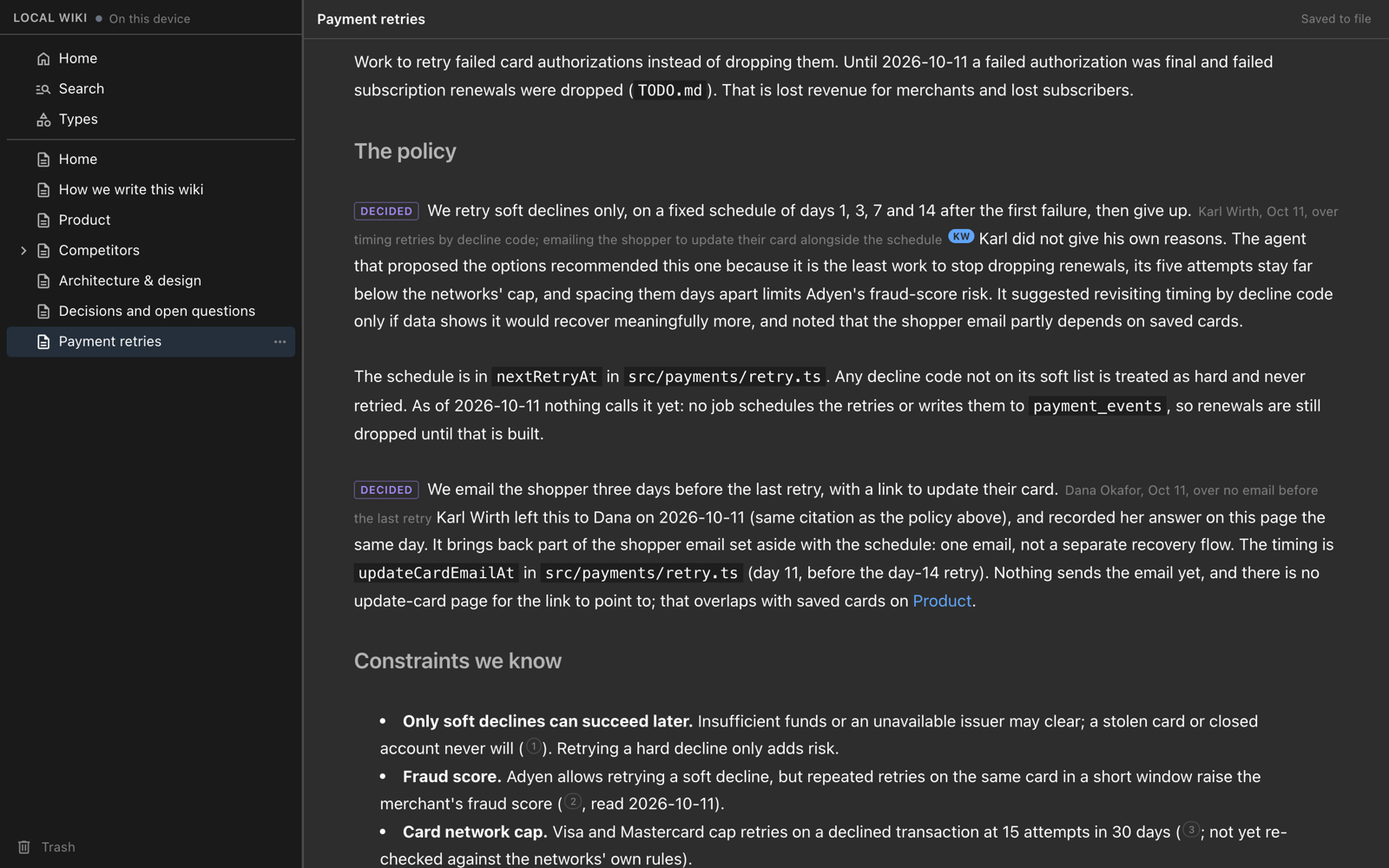
Two decisions on the Payment retries page, each with who decided, when, and what was passed over.
Quotes from the session
When your own words in the session support a decision, the agent adds a citation copied from the session transcript, so the page shows what you said instead of a paraphrase. In Claude Code, the plugin's nimbalyst-session server provides these. It reads only the current session's transcript, on your machine.
The agent never invents a decision, a reason, or a quote. If you did not give a reason, the page says so.
Session citations read Claude Code transcripts only. Decisions recorded from Codex and other agents carry your name and the date but no quote from the session.
The end-of-session reminder
In Claude Code, the plugin reminds the agent once to run capture when a session with substantial work ends, such as a commit, a plan, or several file edits. The reminder names the pages the session's changes touched. Set NIMBALYST_WIKI_NUDGE_MIN_EDITS to change how many file edits trigger it.
Codex does not run plugin hooks, and Cursor, VS Code, and Cowork use the wiki through nim mcp without the plugin, so none of them get the reminder. Make "record what we decided in the wiki" the last thing you ask in a session.
Good habits
- Capture before you close the session. The agent still has the whole conversation in context, so the reasons come out right.
- Name the decider when it was not you. "Dana decided to keep the old endpoint" gets Dana's name on the mark.
- Read what it wrote. Capture ends with links to the pages it touched. Fix anything recorded too loosely; the next session reads your version.
- Settle open questions in the page. Change an open mark to decided yourself, or ask your agent to, and every agent works from the answer.
To ask the wiki what was decided later, see Ask the Wiki What Was Decided.
Guide: Architecture decision records written by your coding agent shows how captured decisions replace a hand-kept decision log, with a template you can use.